
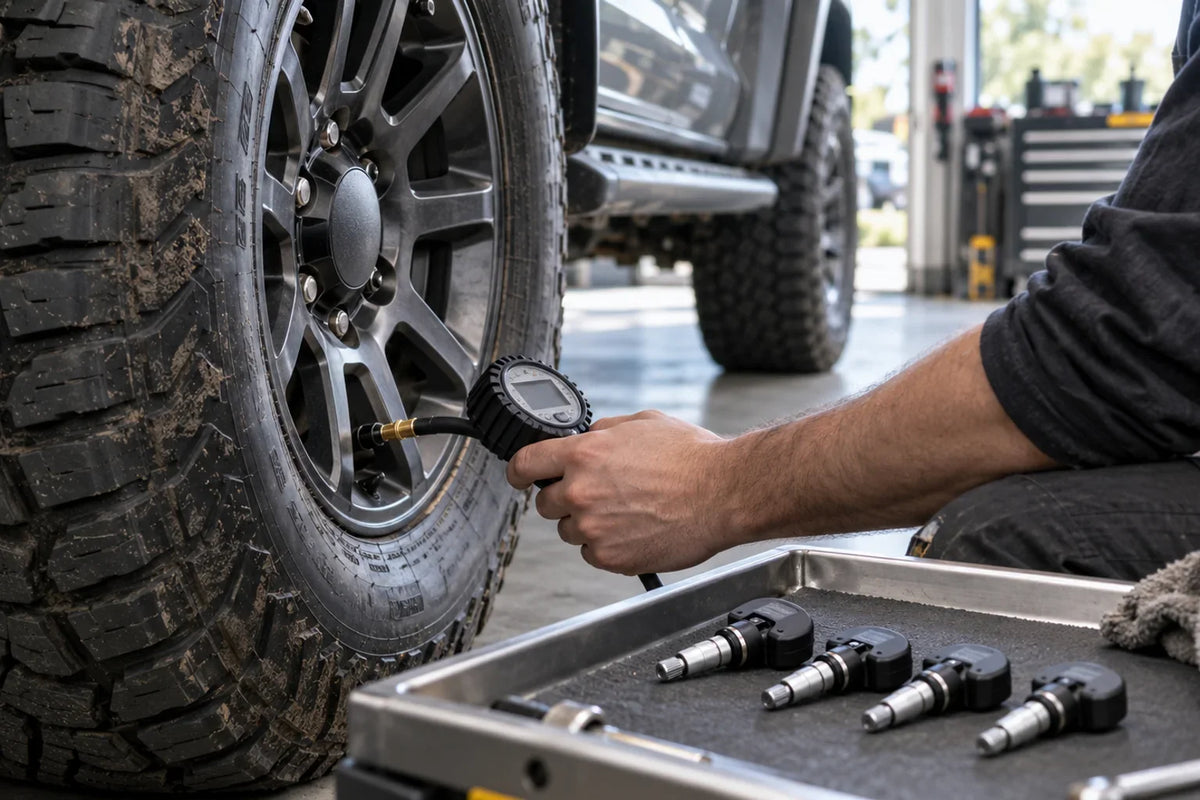
Buy a single TANK 500 tyre-pressure sensor only when a qualified diagnosis points to one failed unit; consider a four-pack when the job genuinely involves four compatible wheel positions. The current Decision Maker 4X4 listing offers “1 Sensor – Matte Black” and “4 Sensors – Black” selections. Those variant names tell you the quantity sold, but not whether a sensor will pair with every TANK 500 year, grade, powertrain or wheel. A dashboard warning alone is not a parts diagnosis.
This is a purchase-planning guide, not a repair instruction or a fitment certificate. We have not independently tested these sensors on every Australian TANK 500. Before ordering, confirm your exact vehicle details and the installer’s pairing requirements with the seller and a qualified tyre shop.
Catalogue and sources checked 3 October 2026. The cover is a generic AI concept, not a photograph of a fitted TANK 500 component. The three graphics below are original editorial explainers. Product options and compatibility advice may change.
What does the listing actually offer?
| Current selection | What it means | A sensible starting question |
|---|---|---|
| 1 Sensor – Matte Black | One listed sensor, not a complete four-wheel set. | Has the faulty wheel position and sensor been confirmed? |
| 4 Sensors – Black | Four listed sensors. | Are four sensors needed for the intended wheel set, and can all four be matched and paired? |
The product description asks buyers to confirm vehicle compatibility and any programming or pairing requirements before purchase. It does not publish an OE part number, radio frequency, a year-by-year Australian fitment chart, or a guaranteed procedure for a 2026 diesel or a particular PHEV. We will not infer those details from the word “TANK 500” in the title.

When might one sensor be the right order?
If a tyre shop or service technician has identified a particular failed sensor, a one-sensor purchase can avoid replacing functioning units merely because a warning appeared. First ask whether the warning could instead come from low pressure, a leaking valve, a tyre problem or a pairing issue. Ask the technician to identify the affected wheel and explain what evidence supports the diagnosis. That avoids buying a component before confirming the problem.
Match the replacement to the vehicle’s system and the wheel it will be fitted to. A cosmetic colour in a variant name is not an electronic specification. Ask the seller to confirm the exact sensor identification and any required setup before a fitter removes the tyre. If the original sensor is still available, a clear photo of its markings may help the supplier match it; do not assume visual similarity proves compatibility.
A single-unit order is not automatically the cheapest completed repair if the tyre must be removed and refitted, or if pairing equipment is needed. Get the total installed quote and ask what happens if the part does not communicate with the vehicle. Do not attempt to clear a warning by simply fitting an unverified sensor.
When might a four-pack make more sense?
Four sensors may be relevant if you are setting up a separate set of four wheels, or a technician has documented multiple failed units. Buying four merely because the pack exists is not a reason to discard working original sensors. For an aftermarket wheel set, check wheel and valve compatibility as well as the vehicle electronics. The seller and fitter should agree on the selected sensor, installation method and pairing plan before work starts.
A four-pack also does not prove a fifth sensor for a spare wheel is included or needed. The current product variants describe one or four units; they do not state a spare-wheel monitoring configuration. Ask the vehicle dealer or tyre professional whether your exact TANK 500 monitors the spare, and buy for the confirmed setup rather than an assumed five-wheel system.

Four checks before the tyre comes off
- Vehicle identity: supply the exact TANK 500 model year, grade and powertrain. If it is a newer diesel or PHEV, request explicit confirmation rather than extending an earlier fitment claim.
- Wheel and valve: tell the fitter whether the wheels are factory or aftermarket. Ask whether the sensor body and valve can be installed correctly in that particular rim.
- Pairing and programming: ask how the sensor will be recognised by the car and whether the chosen shop has the equipment and procedure for your version. The product listing flags this issue but does not guarantee a universal method.
- Quantity and service scope: establish whether the job is a single replacement, a four-wheel set or something else; include tyre removal, sealing, balancing and final testing in the quote where applicable.
Our TANK 500 modification guide is useful when planning wheel and touring changes together, but it cannot certify an individual TPMS sensor for your vehicle. Ask the seller to record the agreed part and variant in writing.
What should happen after fitting?
Have the installer check the tyre and valve for leaks, confirm the vehicle recognises the fitted sensor or sensors, and verify that any warning has been resolved for the right reason. A warning light going out does not, by itself, prove that the tyre is correctly inflated or that a valve is sealed. Ask what follow-up is needed if a warning returns.
RACV's tyre-maintenance guidance recommends checking pressure with an accurate gauge even where a TPMS is fitted. It advises checking tyres cold or cool, using the vehicle manufacturer’s pressure placard, and accounting for load or towing instructions. The spare tyre, if fitted, also needs a manual pressure check. Treat TPMS as an alerting aid, not a substitute for routine tyre maintenance.

The practical buying answer
Choose one only for a diagnosed single-sensor replacement with confirmed compatibility. Choose four only when the wheel project or documented failures actually call for four, again with confirmed compatibility and a pairing plan. If neither diagnosis nor fitment is clear, pause the order and ask the tyre shop and seller to resolve those questions first. You can then compare the live one- and four-sensor selections knowing what work you are paying for.
Frequently asked questions
Does a TPMS warning mean the sensor has failed?
Not necessarily. Check tyre pressure and condition and have the vehicle diagnosed. Do not buy a sensor solely from the warning symbol.
Does the four-pack include a spare-wheel sensor?
The listed four-pack is four sensors. It does not establish whether your specific vehicle monitors a spare or whether another sensor is needed.
Are these sensors confirmed for every TANK 500 powertrain?
The current listing does not provide that evidence. Confirm the exact model year, grade, powertrain, wheel and pairing requirements before purchase.
Can TPMS replace a tyre-pressure gauge?
No. RACV recommends regular gauge checks, including when a vehicle has a TPMS, and using the manufacturer's pressure information for the actual load and conditions.