A Tank 300 tyre inflator should be chosen as part of a complete air-up system, not just by the product name or a large maximum-pressure number. You need an appropriate air source, its approved power supply, compatible hoses and fittings, and a way to connect to the tyre and measure pressure. Some products combine these functions; others are only one component.
For Australian touring, start with the job: occasional pressure corrections at home, restoring pressures after a permitted off-road trip, or supporting several vehicles. Those are different workloads. This guide helps you check what a kit actually includes and what information to request before relying on it away from a service station.
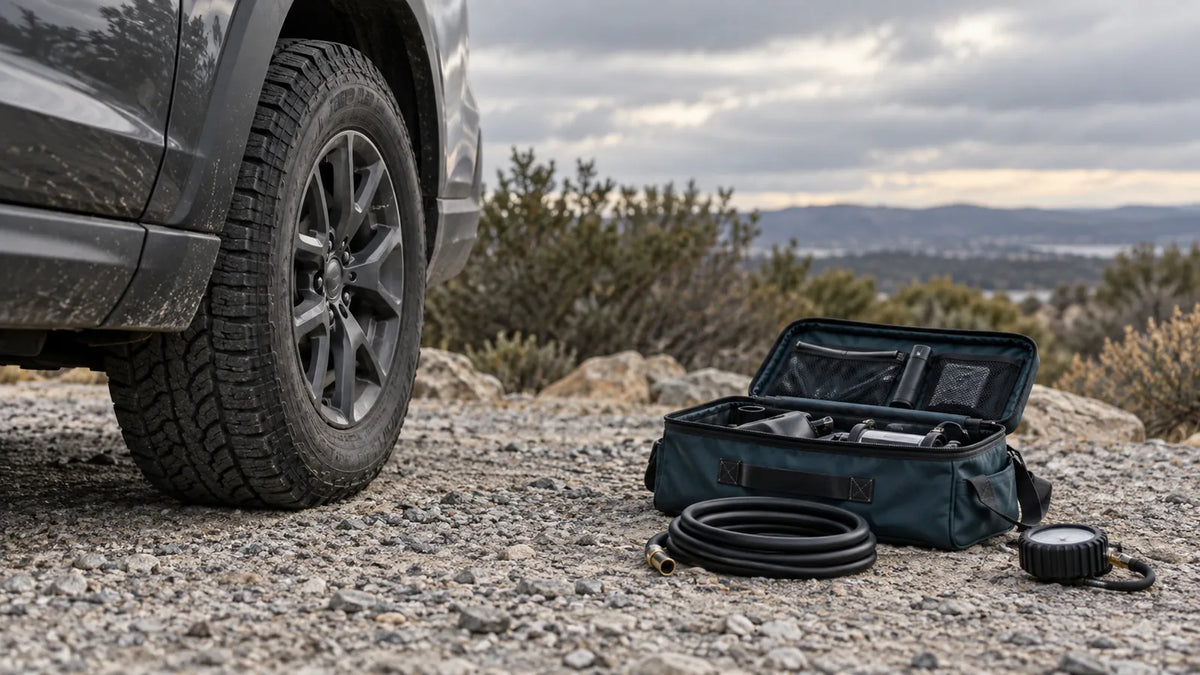
Cover: AI-generated trip-preparation scene with generic equipment, not a product test or a photograph of a supplied kit. Product information checked on 9 September 2026. No universal Tank 300 tyre-pressure setting is prescribed here.
Inflator, compressor or complete kit?
The word inflator can describe different equipment. A compressor supplies compressed air. A hand-held inflator may control air coming from a separate source and include a gauge, but that does not mean it generates air itself. A storage reservoir, if a system uses one, is another component rather than proof of a complete compressor package.
For a clear example of the naming distinction, ARB describes its digital tyre inflator as a device for inflation, deflation and measurement that works with its compressor system. That example explains the terminology; it does not establish compatibility with our products or make them equivalent to ARB equipment.

Think in three groups: air supply and power; hose and matching connections; tyre connection and pressure measurement. Obtain a parts list that covers each group. Do not infer that a gauge, cable, motor, hose or carrying case is included just because it appears in the background of a photograph.
If you already own a compressor, you may only need a compatible hose or control tool. If you own none of the components, an accessory-only purchase will not solve the whole problem. List what you already have before comparing kits.
Match the kit to your workload
Describe the task with your actual tyre size, the number of tyres and the intended pressure change. A quick top-up is not the same job as refilling four tyres through a larger pressure range. Add trailer tyres or another vehicle only when the equipment documentation supports that workload.
On a phone, swipe the table sideways to see all columns.
| Your intended use | Information to request | Do not assume |
|---|---|---|
| Occasional top-ups | Compatibility with your tyre size, power source, pressure range and gauge requirements. | A compact unit is automatically suitable for every vehicle tyre. |
| Four-tyre touring refill | Documented refill performance at a stated tyre size and pressure change, plus running and cooling limits. | A one-tyre time can simply be multiplied by four without cooling breaks. |
| Several vehicles or a trailer | Permitted repeated workload, total reach and any operating restrictions. | A kit adequate for your own vehicle can run indefinitely for the group. |
For planning, separate total time into setup, inflation, any required cooling pauses and packing away. This is a budgeting method, not a predicted performance figure. If a seller gives a refill time, ask whether it includes pauses and what tyre, starting pressure, finishing pressure and ambient conditions were used.
Keep this purchase in proportion to the rest of your trip preparation. Our Tank 300 upgrade-priority guide helps place individual accessories within a broader build rather than buying equipment without a defined use.
Check power, airflow and duty cycle together
Do not assume a compressor can use a cabin accessory socket. Request the specified voltage, current draw, fuse protection and connection method. Match them against the vehicle instructions and the equipment manufacturer’s requirements. A plug that physically fits is not evidence that the circuit is suitable.
Petrol, hybrid and other vehicle versions should not be treated as interchangeable electrical installations. If you are considering a permanent installation, have the mounting and wiring assessed by an appropriately qualified installer. This article does not provide wiring instructions, battery connection points or a fuse value.
Compare airflow figures only when the test conditions are stated. ARB’s CKMP12V2 service and parts manual, for example, separates no-load airflow from airflow at tyre pressure and states duty-cycle conditions. That is a useful documentation format to request, not a set of specifications to apply to another product.
- Maximum pressure: a pressure figure alone is not a refill-time result.
- Airflow: ask at what pressure and under what conditions it was measured.
- Duty cycle: ask for the permitted running period, required rest period and applicable conditions.
- Protection: ask what the instructions require if the unit becomes hot or stops.
A thermal cut-out, where fitted, is not an invitation to keep restarting an overheated unit. Follow the actual operating instructions, and do not plan around protection features that have not been confirmed for the chosen model.
Check hose reach and connections before the trip
Measure the route from the proposed operating position to every tyre, including the spare if it is part of your pressure-check routine. Use the route the hose will actually take around the vehicle, not a straight-line measurement through the body. Account for any trailer separately.
Ask for the usable hose length and the identification of both end fittings. Confirm the tyre chuck suits your valves and can be used without an awkward bend against the wheel. A close-looking connector is not enough: the supplier should identify the matching coupling and the hose’s operating limits.

Inspect your existing equipment while it is disconnected and unpressurised, following its instructions. Record the model and marked specifications; do not dismantle a fitting to identify it. Send clear close-up photographs if needed, but request written confirmation rather than treating an image comparison as a pressure-rating check.
Our packing recommendation is to keep the gauge, hose and compatible accessories together in a protective case or bag, positioned where they remain accessible after loading the vehicle. Secure the kit for travel and avoid burying it under the items you would need to unload beside a road. See our Tank 300 trunk-storage checklist for the separate cargo-layout questions.
What our current listing establishes—and what it does not
Our Multifunctional Off-Road Tire Inflator for GWM Models is listed as a tyre-inflation accessory for compatible GWM vehicles, including Tank models. It has one current product option. The description asks buyers to check the hose, connector and power requirements against their setup.

The photographs show a cylindrical metal assembly, a gauge and hoses across the image set. They do not, by themselves, establish the complete supplied package or whether an external air source is required. We therefore do not describe this listing as a verified, ready-to-run Tank 300 compressor kit.
The current description does not specify supply voltage, current draw, airflow, duty cycle, measured refill time, hose length or gauge accuracy. Exact model years and powertrain compatibility also require confirmation. Request those details and the operating instructions before ordering for a particular touring task.
The listing advises monitoring pressure with a reliable gauge, not leaving the inflator running unattended, keeping it away from water, accumulated sand and excessive heat, and allowing cooling when required. These cautions do not replace a model-specific manual. Do not use product photos as instructions for connecting, pressurising or modifying an air system.
Plan pressure checks, not guesswork
The equipment’s maximum-pressure rating is not the tyre pressure you should use. For the relevant vehicle and tyre combination, begin with the vehicle’s pressure information and owner instructions. Michelin’s recommended-pressure guide explains where to find that information and notes that front/rear and loaded/unloaded recommendations can differ. If you have changed tyre size or specification, seek advice for the actual setup rather than copying another owner’s number.
Michelin recommends checking pressures when tyres are cold, regularly and before long journeys. It also explains that driving raises tyre temperature and pressure; bleeding a warm tyre down simply to match a cold target can leave it underinflated after cooling. See its tyre-pressure checking guidance. Follow the relevant guidance for warm tyres rather than improvising a correction.
For a trip involving reduced off-road pressures, establish an appropriate pressure plan and a way to restore suitable road pressures before starting. This article does not prescribe a sand, rock or highway PSI value, or authorise travel at reduced pressure. Conditions, tyres, loading and operating limits need their own assessment.
Keep a reliable gauge available, and understand the units shown on it. If a tyre repeatedly loses pressure or has visible damage, treat that as a fault to assess, not a reason to keep adding air indefinitely. Michelin recommends professional inspection for significant pressure differences. An inflator does not repair a damaged tyre.
Plan somewhere safe and suitable to stop, then follow the equipment’s instructions throughout use. This is a buying guide, not a tyre-repair, bead-seating or compressed-air-system modification procedure.
Send a useful equipment enquiry
Before buying, give the supplier enough information to answer a specific question. You can use this brief:
- Vehicle model, year and powertrain.
- Tyre size and whether you also need to service a trailer.
- Intended use: top-ups, a four-tyre refill or a larger workload.
- Existing compressor, gauge and hose model numbers, if any.
- Planned power source and operating position.
- Required hose reach and available storage space.
Ask for an itemised package list, compatible connections, electrical requirements, airflow test conditions, running/cooling limits and the current instructions. If key information is missing, resolve it before depending on the kit for a remote trip. A useful answer should describe the equipment and your intended task, not just repeat the vehicle badge.
Check the complete setup before ordering
Send your Tank 300 details, tyre size and existing equipment list. We can review the current listing and identify the compatibility or specification questions that still need an answer.
Ask about a tyre-inflation setupFrequently asked questions
Does every tyre inflator include a compressor?
No. The name may describe a control tool or accessory that needs a separate air source. Confirm the supplied components and what else is needed to operate them.
Can I plug it into my Tank 300’s accessory socket?
Only when the equipment and vehicle instructions establish that connection is suitable. The current store listing does not provide the electrical specifications needed to make that claim.
Will a higher maximum PSI inflate tyres faster?
That number alone does not establish speed. Request documented performance at relevant conditions, together with airflow and running/cooling limits.
What pressure should I use in my Tank 300?
Use the guidance for your exact vehicle, tyres and load. This article supplies no universal pressure value. Obtain suitable advice for changed tyre specifications and off-road use.
Do the store photos confirm a complete touring kit?
No. The images help identify the listed equipment, but a parts list and operating specifications are still needed. Do not assume background equipment is supplied.
Bottom line: buy a complete, documented solution to your inflation task—not an isolated component whose role or limits are unclear. Confirm the air source, power, connections, pressure control and operating limits before you count on it.
Editorial note: Prepared with AI assistance by the Decision Maker 4X4 Editorial Team from the linked live store listing and primary manufacturer guidance. The cover and component graphic are AI concepts; two product images come from our store. No hands-on refill testing, electrical fitment, product equivalence, certification or measured performance is claimed. Other manufacturers’ specifications do not apply to our listed item.