
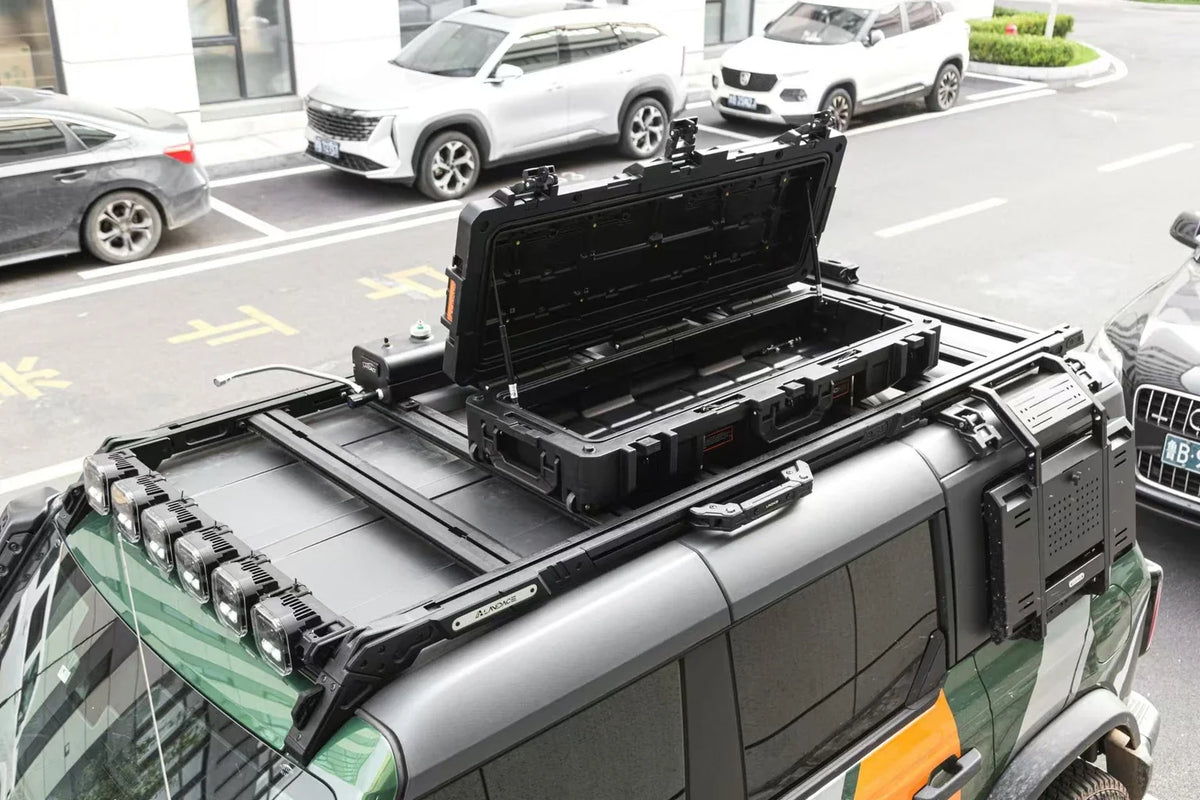
A Landace roof box only solves a storage problem when the actual box, mounting kit and roof-load allowance work together. Our Landace Roof Storage Equipment Box listing describes an external equipment case for suitable rack or crossbar systems, but does not publish a complete dimension, capacity or weight specification. Start with those missing details, not a litre figure borrowed from a similar-looking case elsewhere.
Listing and gallery checked 21 October 2026. The cover and two product photographs below come from our website. We have not installed, weighed or weather-tested this box. The cover shows an example installation; its platform, lights and surrounding accessories are not an inclusion list.
In this guide:
- 1. Confirm the supplied box and hardware
- 2. Measure usable space and access
- 3. Build the complete roof-load calculation
- 4. Match the mounting system
- 5. Separate construction from certification
- 6. Check roof layout and overall height
- 7. Plan packing and handover
- Common questions
1. What box and hardware are actually supplied?
The current selector has one default variant. It does not offer a clear size menu or a packing list that identifies every attachment. Several gallery photographs show two cases stacked together. That is useful for seeing the case shapes, but it should not be read as confirmation that an order contains two boxes, that the boxes are identical sizes or that stacking is approved during travel.
Ask for the current product code, box quantity, colour, included fittings and installation instructions. Identify any brackets, clamps, backing pieces and keys separately. Request a photo of the actual supplied set if it differs from the gallery. This avoids a common planning mistake: buying an attractive case and discovering later that the mounting arrangement in the photograph was a separate accessory.

2. Which dimensions matter more than capacity?
Request both external dimensions and usable internal dimensions. Record the narrowest internal width, floor length and available depth below the closed lid. Moulded corners, internal fittings and lid ribs can make a rectangular item harder to pack than the nominal volume suggests. Ask how much extra space is needed to reach the latches and open the lid once the box is mounted.
For example, imagine a camping bag measuring 800 × 300 × 180 mm. Those are hypothetical bag dimensions, not Landace specifications. You need to compare its packed shape with the actual case interior, including any narrowing around the corners. A litre rating alone would not show whether that bag fits flat or whether it prevents the lid from closing normally. Make a short list of intended items before requesting measurements.
3. Have you counted the box as well as its contents?
Obtain the empty mass of the exact box and all its mounting hardware. Add the rack system, other roof accessories and the intended contents. Rhino-Rack's roof-box guidance explains the general accounting principle: the vehicle's permitted roof load includes the rack, box and cargo. That is a useful principle, not a transfer of Rhino-Rack's product ratings to Landace.
As a calculation example only, 20 kg of rack, 3 kg of mounts, a 12 kg empty case and 15 kg of contents total 50 kg. None of those figures is a specification or recommended limit for this product or a GWM vehicle. Compare your measured total against the applicable vehicle, rack, mounting and accessory documentation, including any different off-road conditions. Our TANK 300 roof-load planning guide explains why an empty-looking roof can already contain significant accessory mass.
4. Does the mounting method suit your rack?
The Landace listing allows for compatible luggage-rack or crossbar installations; it does not establish universal fitment. Send the seller your rack brand, model, bar spacing, bar profile and photographs of available fixing positions. Ask which specific hardware joins this box to that supporting system and whether it is included.
The installed gallery image shows one possible arrangement, not a drawing for every platform. Have a competent fitter review the documented attachment points and access for securing and inspecting the fasteners. Do not treat unused holes, slots or a flat case floor as permission to improvise a mounting pattern. If choosing a new platform too, confirm the rack-and-box combination before ordering either item.

5. What protection claims are documented?
The listing's legacy URL contains an “explosion-proof” translation, but the product description expressly does not claim a certified explosion-proof rating without separate manufacturer documentation. A rugged case shape, strong-looking latches or that wording in a URL is not a certification. Ask for the specific test report or rating if your intended use needs a defined protection standard.
Apply the same approach to water and dust protection. Request the actual documented claim, its conditions and maintenance instructions rather than assuming a sealed-looking lid provides a particular ingress rating. Decide what should be placed in separate protective packaging. Choose ordinary touring storage around verified instructions; do not use an unverified marketing term as the basis for storing hazardous materials.
6. Can you open it and still use the rest of the roof?
Sketch the platform from above with the box, awning, water equipment and any other roof accessories in their actual positions. Include the lid's opening arc and the space needed to operate the latches. A layout can fit with everything closed yet become awkward when a deployed awning blocks the same side used to reach the case.
Request the installed height, including the rack and mounting arrangement, and measure the completed vehicle before relying on a garage clearance. Include the highest protruding component, not just the case shell. Also plan how you will load and retrieve equipment using appropriate access equipment without standing on an unrated accessory. For nearby equipment, see our GWM side-awning comparison.

7. How will you pack and inspect it?
Group the intended contents before buying so the case has a defined job. A bag of seldom-used lightweight camp equipment creates a different access pattern from tools needed at every stop. Keep internal movement and closure in the plan: ask how items are restrained, how latches indicate engagement and what inspection interval the manufacturer specifies.
At handover, compare the delivered case and fittings with the agreed packing list. Keep the instructions, mounting details and documented limits with the vehicle records. Before travel, follow that procedure for contents, closure and mounts rather than assuming a locked latch proves every fixing is secure. Send your rack details and packing plan through our contact page before ordering if any of these inputs remain unanswered.
Common questions
Is this listing for two boxes?
The gallery includes stacked cases, but the current default variant does not provide a box-by-box packing list. Confirm quantity and version with the seller instead of reading the display photograph as two units included.
Can I use a capacity listed by another Landace seller?
Not without matching the exact manufacturer product code and specification. Similar branding and case shapes do not establish identical volume, dimensions, empty mass, fittings or protection ratings.
Does a roof box increase my vehicle's roof-load allowance?
No. It adds its own mass and a separate set of mounting and use limits. Use the documentation for the complete vehicle and supporting system; calculate the box and contents within that arrangement rather than treating enclosed cargo as exempt.


