
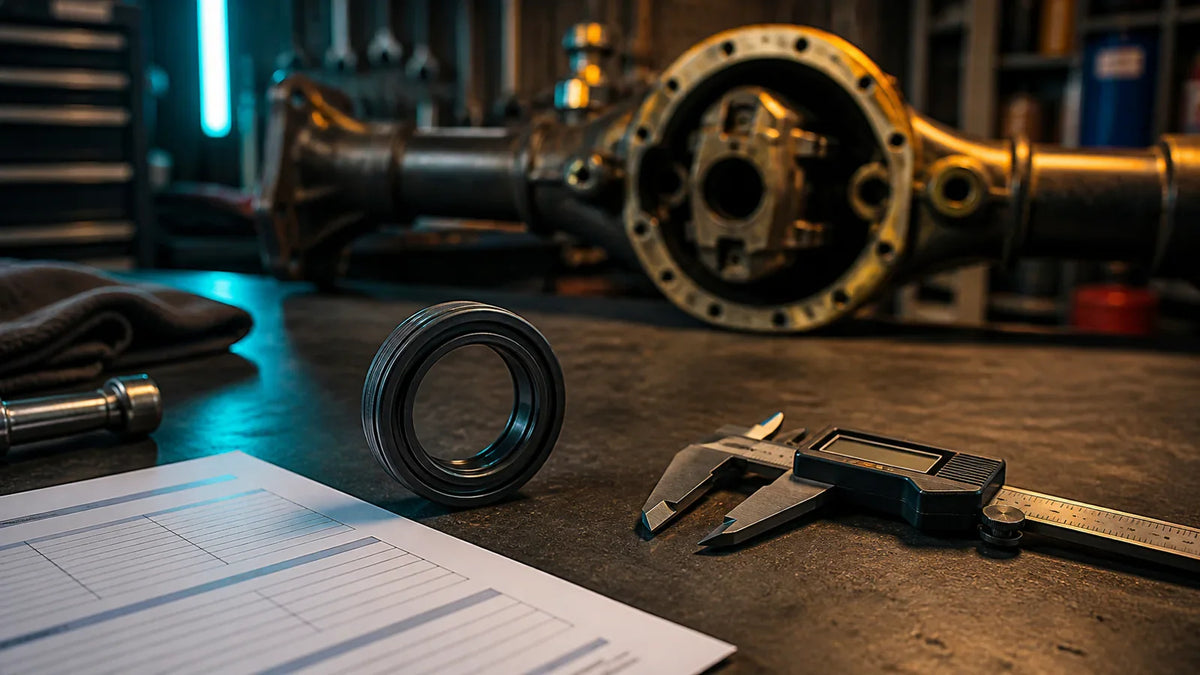
GWM part 2302700XKV73A is commonly identified as the left axle-shaft or left half-shaft oil seal. A third-party Tank 300 electronic parts catalogue places it in a front gearbox/differential assembly and names it the “left half shaft oil seal”. Independent trade data uses the description “OIL SEAL-AXLE SHAFT LH”. However, aftermarket catalogues disagree about the complete vehicle list, so the part number alone is not enough to confirm compatibility.
Before ordering, match the VIN, market, model code, build date, powertrain, front differential assembly number and any supersession. Ask a GWM parts department or a qualified parts specialist to return a written VIN-based match. Decision Maker 4X4 does not currently sell 2302700XKV73A, and the related products later in this guide are not substitutes for the seal.

Illustrative fitment workflow. It is not proof that the part suits a particular vehicle.
What is GWM part 2302700XKV73A?
The strongest public evidence we found describes 2302700XKV73A as an oil seal used at a left axle or half-shaft output. The third-party Tank 300 EPC lists one unit within front gearbox assembly 2302200XKM01A for model code CC2030BE21A. Separately, trade-shipment data records the same reference as “OIL SEAL-AXLE SHAFT LH”.
Those sources agree on the component type and left-side wording. They do not establish universal fitment, current supersession status or the correct specification for every Australian-delivered Tank 300.
An axle-output oil seal is a small component with an important job: it helps retain lubricant inside the differential housing while the shaft rotates. A typical seal combines an elastomer sealing surface, internal reinforcement and a spring-loaded lip. Exact dimensions and materials must come from the verified part specification—not from a generic image or a visual comparison.

Generic construction illustration only. It does not show the exact dimensions or material specification of 2302700XKV73A.
Why do online fitment lists conflict?
Some sellers list 2302700XKV73A for the Tank 300. Others associate it with the Haval H9, GWM Poer or additional models. That does not necessarily mean every listing is wrong: manufacturers can share components across platforms, and a reference may appear in more than one assembly. But a shared number in a seller database is not the same as a VIN-confirmed match.
Conflicts commonly come from:
- copied aftermarket catalogue data;
- market-specific vehicle names and specifications;
- production changes within the same model year;
- a part number that has been replaced or superseded;
- left/right descriptions translated differently;
- a listing that combines several variants under one product page;
- confusion between a seal, a seal assembly and a related retainer.
Treat marketplace titles, search snippets and photographs as leads. Use an EPC record tied to the exact vehicle and assembly as the decision evidence.
Seven details to verify before ordering
1. VIN or chassis number
The VIN is the best starting point because it connects the vehicle to its market and production specification. Share it only through a trusted parts channel. Ask for the matching catalogue diagram and line item, not just a verbal “yes”.
2. Market and model code
An Australian-delivered Tank 300 may not be identical to a vehicle sold under the same name elsewhere. Record the market and the model code shown in the relevant parts system. The public EPC example above uses CC2030BE21A; that code should not be assumed for every Tank 300.
3. Build month and year
Model-year labels are broad. A change can occur during production, so capture the build date from the vehicle identification plate and ask whether the catalogue has a date split.
4. Powertrain and driveline configuration
Confirm engine, transmission and driveline specification. Do not infer the correct seal from exterior trim or badge level.
5. Differential or gearbox assembly number
The public Tank 300 diagram associates the part with a named front assembly. Ask the parts specialist to confirm the assembly fitted to your vehicle and whether its component callout still uses 2302700XKV73A.
6. Left-side definition
Automotive parts catalogues normally describe left and right from the seated driver's perspective, but translations and seller pages can be inconsistent. Ask the supplier to mark the position on the vehicle-specific diagram. Do not rely on a product photo, because a round seal may not show its application or side.
7. Current supersession and supply type
Ask whether 2302700XKV73A is current, superseded or replaced as part of a kit. Also establish whether the quote is genuine GWM supply, an OE-supplier part or an aftermarket equivalent. “OEM” is used loosely online; request the manufacturer, packaging and warranty terms in writing.
Where is the seal located?
The catalogue description and assembly context place the seal at the left half-shaft/output interface of a front differential-type housing. The shaft passes through the seal as it enters the housing. The diagram below explains that general relationship; it is not a Tank 300 workshop manual or a removal sequence.

Location concept only. Use the manufacturer procedure and vehicle-specific workshop information for service.
Do oil marks prove the seal has failed?
No. Oil near a shaft opening may be consistent with a seal leak, but the visible wet area can have another source. Fluid can travel across a housing or protective plate before it drips. Residue from an earlier repair can also remain.
A qualified workshop should clean the area, identify the fluid, inspect the housing and breather, check the shaft and surrounding joints, and confirm the actual leak path. Noise or vibration should not automatically be blamed on the seal; those symptoms need separate diagnosis.
If the differential fluid level may be low, avoid extended driving until the vehicle has been assessed. The safe response depends on leak rate, fluid level and operating conditions.
What should the workshop check during replacement?
This is a driveline repair rather than a cosmetic accessory installation. The workshop should use the correct service procedure and confirm at least the following:
- correct seal orientation, installation depth and suitable driver tool;
- shaft sealing surface condition, run-out and unwanted movement;
- housing bore condition and evidence of previous damage;
- differential breather operation and possible pressure build-up;
- correct lubricant specification and final level;
- replacement requirements for retaining hardware or one-time-use parts;
- fastener torque and any required post-repair checks.
Replacing only the rubber seal without finding a worn shaft surface, damaged bore, blocked breather or bearing movement can allow the leak to return. Ask the workshop to record what it found and the exact part number installed.
A practical parts-counter checklist
| Evidence | What to request | Acceptable result |
|---|---|---|
| Vehicle identity | VIN, market and model code match | Written match to your vehicle |
| Production detail | Build date range | Vehicle falls inside the catalogue range |
| Assembly | Front differential/gearbox number | Same assembly shown in the EPC |
| Position | Marked catalogue diagram | Left output location is unambiguous |
| Part status | Current number or supersession chain | Supplier explains the number being supplied |
| Supply type | Genuine, OE-supplier or aftermarket | Brand and warranty are stated |
| Workshop scope | Seal plus required fluids/hardware | Complete quote without hidden assumptions |
Keep a copy of the quote, the vehicle details sent to the supplier and the diagram used to confirm fitment. This creates a useful record if the delivered component differs from the order.
Does Decision Maker 4X4 sell 2302700XKV73A?
Not at the time of review. We found no active Decision Maker 4X4 product with this exact part number, so this guide is an identification and fitment resource—not a product claim.
For Tank 300 underbody planning, our store currently lists the MK manganese-steel chassis guard, MK 8 mm chassis guard, ZOOKAY 8 mm chassis guard plate and XGR aluminium-magnesium guard. These are protection products, not axle seals, and each has its own vehicle and installation requirements.
If you are planning several modifications, start with our Tank 300 accessories upgrade-order guide. For front-end work, the Tank 300 bull bar fitment checklist explains why vehicle identity, sensor layout and installation evidence matter before purchase.
GWM part 2302700XKV73A FAQ
Is 2302700XKV73A a Tank 300 part?
A third-party Tank 300 EPC lists it as a left half-shaft oil seal in one front gearbox assembly. That is useful evidence, but it does not prove compatibility with every Tank 300. Confirm the exact vehicle by VIN and assembly.
Is it a front differential oil seal?
The public Tank 300 catalogue context places it in a front gearbox/differential assembly at the left half-shaft position. Seller terminology varies, so use the vehicle-specific diagram when speaking with the parts department or workshop.
Will the same seal fit a Haval H9 or GWM Poer?
Some aftermarket lists associate the number with those models, but their coverage is inconsistent. Do not transfer fitment from one vehicle to another without a VIN-based parts lookup and current supersession check.
Can I identify the correct seal by measuring the old one?
Measurements can help a specialist investigate, but they do not replace application data. Lip design, material, direction, shaft surface and housing specification also matter. Use the verified part record as the primary evidence.
Should I replace it as a DIY job?
The repair can involve driveline disassembly, fluid handling, retaining hardware and inspection of the shaft and housing. A qualified workshop with vehicle-specific service information is the safer choice.
Final recommendation
Use 2302700XKV73A as a search and catalogue reference, not as the final fitment decision. The available evidence consistently identifies a left axle/half-shaft oil seal, while the full vehicle coverage remains inconsistent across third-party sources. Confirm VIN, market, model code, build date, assembly, side and supersession in writing before ordering. Then have the leak source and adjacent components checked by a qualified workshop.
Reviewed by the Decision Maker 4X4 Editorial Team on 28 August 2026. Catalogue data, product availability and supersessions can change; verify current details before purchase or repair.


