
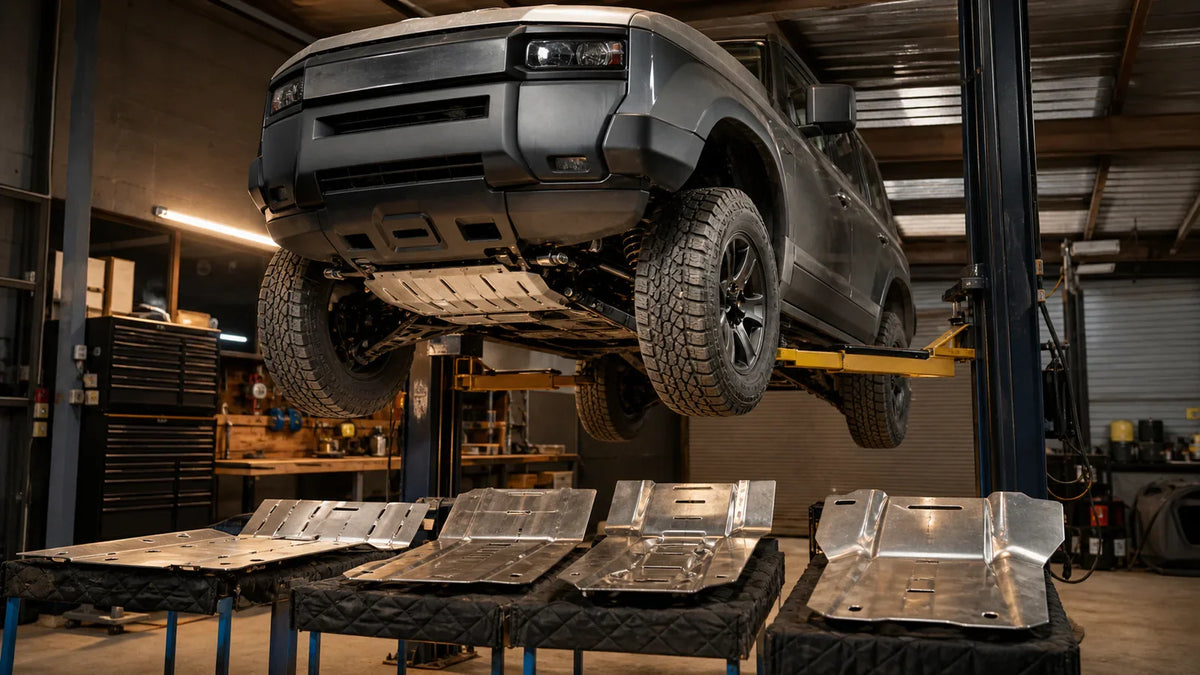
For a Tank 300 bash plate, steel is usually the heavier, highly repairable choice for repeated hard contact, while aluminium alloy reduces added mass and resists red rust. Neither material is automatically better. Coverage, plate shape, mounting strength, clearances and the exact Petrol or Hybrid fitment can matter more than the material name or a headline thickness.
Choose the protection system by answering three questions: what terrain will the vehicle encounter, which underbody zones need protection, and how much accessory weight is already planned? Then compare the complete kit—including brackets and fasteners—rather than comparing one steel thickness with one aluminium thickness in isolation.

Illustrative coverage map. Confirm the actual Tank 300 variant and the parts included in the selected kit.
What is a Tank 300 bash plate?
A bash plate is a formed shield mounted below vulnerable vehicle components. You may also see the terms skid plate, underbody protection, underbody guard or chassis guard. Sellers do not always use those names consistently, so the product title alone does not show what is protected.
A Tank 300 system may include one plate or several linked plates covering some of these areas:
- the front lower area and radiator approach;
- engine sump;
- gearbox or transmission;
- transfer case;
- front or rear differential area;
- fuel tank;
- exposed pipes, wiring or hybrid-specific components where the manufacturer has designed compatible protection.
Ask for a labelled component list and an underside diagram. “Full kit” should be treated as a claim to verify, not a standard definition.
Coverage comes before steel versus aluminium
A strong engine plate cannot protect a transfer case or fuel tank that remains exposed. Before choosing material, inspect the vehicle and mark the likely contact zones for the way it will be used.
For graded roads and touring, protection against stones, ruts and occasional contact may be the priority. On slow rocky tracks, plate overlap, leading edges and mounting-point strength become more important. Sand and mud add another question: can debris drain and can the area be cleaned without trapping material against heat-producing components?
Request current photos of the complete kit laid out on the floor and fitted to the same Tank 300 version. Count the pieces, brackets and fasteners. Confirm whether a bumper, bull bar or winch changes the front plate required. Our Tank 300 bull bar fitment checklist explains why front accessory interfaces should be checked together.
Steel Tank 300 bash plates
Steel offers high stiffness and impact resistance in a relatively thin section. It can often be straightened or welded by a suitably equipped workshop after damage, depending on the grade, coating and deformation.
The trade-offs are added mass and corrosion management. Painted or coated steel can expose bare material when it is scraped, so damaged areas need inspection and appropriate repair. Stainless and specialised structural steels behave differently; “steel” is not a complete specification.
Ask the supplier for:
- the exact steel grade or supplier material description;
- plate thickness and total installed kit weight;
- coating system and repair guidance;
- bracket and fastener material;
- whether drain, inspection and service openings are included;
- photos of formed ribs, welds and mounting transitions.
Steel may suit a buyer who expects repeated slow-speed contact and accepts the weight and maintenance. That is a use-case decision, not a universal recommendation.
Aluminium Tank 300 bash plates
Aluminium alloy provides a useful strength-to-weight balance and does not form red iron rust. A well-designed aluminium plate is normally thicker than a steel plate intended for a similar role, but thickness alone still does not establish equivalent protection.
Alloy grade, temper, bends, ribs, heat-affected zones and bracket design influence the result. Aluminium can gouge or grip when dragged over rock, and repair capability varies between workshops. It can also suffer galvanic corrosion where dissimilar metals and moisture meet if the mounting system is not designed correctly.
Ask for the alloy specification, thickness, complete installed weight, isolation method at mixed-metal contacts and repair policy. Do not rely on “aircraft grade”, “G2” or another marketing label without a supplier specification that connects the term to the actual product.

Material comparison illustration. Final performance depends on the complete design, mounting and application.
Steel vs aluminium: practical comparison
| Decision point | Steel | Aluminium alloy |
|---|---|---|
| Installed weight | Usually higher for a comparable application | Usually lower, useful when payload margin matters |
| Corrosion | Coating damage needs attention; stainless behaves differently | No red rust, but galvanic and surface corrosion still need consideration |
| Trail contact | Can offer high stiffness and puncture resistance | Can provide strong protection with less mass when correctly designed |
| Repair | Many fabrication workshops can straighten or weld common grades | Requires alloy-compatible repair skills and an assessment of damage |
| Thickness comparison | A smaller number is not automatically weaker | Often uses a thicker section; thickness alone is not a performance rating |
| Best use | Repeated heavy contact where mass is acceptable | Touring or modified vehicles where weight efficiency is important |
Do not use this table as an impact rating. Without comparable material specifications, geometry, mounts and test data, it is not valid to say that one listed thickness equals another.
Why the thickest plate is not always the best plate
More thickness adds material, but it can also add weight and transfer higher loads into mounting points. A plate that is extremely stiff but attached to weak tabs may damage those tabs instead of protecting the vehicle as intended.
Good design distributes contact loads through formed sections and suitable mounts. It should avoid sharp exposed edges, preserve ground clearance as far as practical and allow the plates to move or deform in a controlled way. Ask whether the system has been trial-fitted on the exact vehicle version and whether replacement plates, brackets and fasteners are available separately.
Count the full installed weight
The quoted plate weight may exclude brackets, fasteners or another required section. Ask for the complete installed weight and add it to every other accessory: bull bar, winch, recovery equipment, roof rack, storage, auxiliary fuel, passengers and cargo.
Australia's Vehicle Standards Bulletin 14 provides the national technical framework for light-vehicle modifications, while states and territories administer their own requirements. Confirm the vehicle's current mass limits and the rules in its registration jurisdiction. This guide is general planning information, not engineering or legal approval.
Weight low on the chassis may have a different handling effect from roof load, but it still contributes to vehicle mass. Keep a build sheet rather than assessing accessories one at a time.
Confirm Petrol, Hybrid and existing-accessory fitment
“Fits Tank 300” is not enough. Provide the seller with VIN or chassis details where appropriate, market, build date, model year, Petrol or Hybrid powertrain and photos of the underside. Hybrid packaging, shields and service requirements can differ from Petrol configurations.
Also disclose:
- bull bar, front bumper and winch;
- suspension or differential changes;
- tow equipment and recovery points;
- existing factory or aftermarket guards;
- exhaust modifications;
- any wiring, compressor or auxiliary tank fitted below the body.
Ask the seller to confirm the selected variant and every included piece in writing. The Tank 300 accessories upgrade-order guide can help sequence these decisions before multiple parts compete for the same mounting space.
Check cooling, drainage and service access
Underbody protection should not create a new maintenance problem. The workshop should check airflow, heat clearance, drain paths and access to filters, drain plugs and inspection points. A plate may need removal for normal service; if so, ask whether replacement fasteners or torque checks are required.
Mud, sand and stones can collect above a poorly drained plate. After off-road use, inspect and clean the protected areas using a safe lifting method. Check for contact marks, loose fasteners, cracked brackets and rubbing against the driveline, exhaust or wiring.
Noise after installation can come from plate-to-plate contact, insufficient clearance or a loose mount. Do not hide the symptom with foam or sealant until the cause has been identified.
Tank 300 bash plate options in our current catalogue
Decision Maker 4X4 currently lists several different approaches. Product availability and variants can change, so verify the live selection before ordering.
- The MK manganese-steel chassis guard is listed for Tank 300 Petrol and Hybrid, with supplier-listed approximate weight of 24 kg. Confirm model year and existing underbody modifications.
- The XGR aluminium-magnesium chassis guard includes named Tank 300 6 mm and 8 mm options. Confirm the exact variant rather than selecting by thickness alone.
- The NR TH700 underbody guard options separate front lower, front axle and gearbox protection, including with-winch and without-winch configurations.
- The ZOOKAY 8 mm chassis guard plate and RAWME ZOOKAY multi-model guard range provide additional Tank 300-labelled choices with variant-specific notes.

Verified image from the active XGR product record. Confirm the selected Tank 300 variant and what the option includes before ordering.
Eight questions to send the seller
- Does this exact option match my VIN, market, build date and powertrain?
- Which underbody zones and individual plates are included?
- What are the material specification, thickness and complete installed weight?
- Does it work with my bumper, bull bar, winch and recovery points?
- Are drilling, cutting, spacers or removal of factory protection required?
- Are cooling, drainage and scheduled-service access preserved?
- What inspection, fastener and coating maintenance is required?
- Can individual plates, brackets and fasteners be replaced after damage?
Save the written reply with the order. Photograph the underside before installation, at the dry-fit stage and after final fastening.
Tank 300 bash plate FAQ
Is a steel bash plate stronger than aluminium?
Not as a blanket rule. Material grade, thickness, folds, ribs, spans and mounts all affect performance. Steel can provide high stiffness in a thinner section; aluminium can deliver strong protection with lower weight when the complete design is suitable.
Is 8 mm always better than 6 mm?
No. Compare alloy specification, geometry, coverage, mounting, weight and intended use. A thicker plate can add cost and mass without fixing weak mounts or missing coverage.
Do I need a full underbody kit?
It depends on terrain and the exposed components on the exact vehicle. Start with an underside inspection and a coverage map. Do not assume an engine-only plate protects the gearbox, transfer case or fuel tank.
Will a Tank 300 Hybrid use the same bash plate as a Petrol model?
Do not assume so. Confirm the selected part for the exact powertrain, build date and underside layout. Hybrid-related shields, cooling, wiring and service access may change the requirements.
Can I install a bash plate myself?
Some kits may use factory mounting points, but the plates can be heavy and correct support, clearances and fastener procedures matter. Professional installation is sensible when the kit is heavy, multi-piece or interfaces with a winch, bumper or hybrid underbody.
Final recommendation
Choose a Tank 300 bash plate by coverage, complete design, verified fitment and installed weight, then decide between steel and aluminium. Steel can be the practical choice for repeated hard contact and straightforward fabrication repair. Aluminium can preserve more payload margin and avoid red rust. The best answer is the correctly designed system for the vehicle, terrain and complete accessory build—not the thickest number in a product title.
Reviewed by the Decision Maker 4X4 Editorial Team on 29 August 2026. Product options, fitment, regulations and availability can change; verify current details before purchase or installation.


