
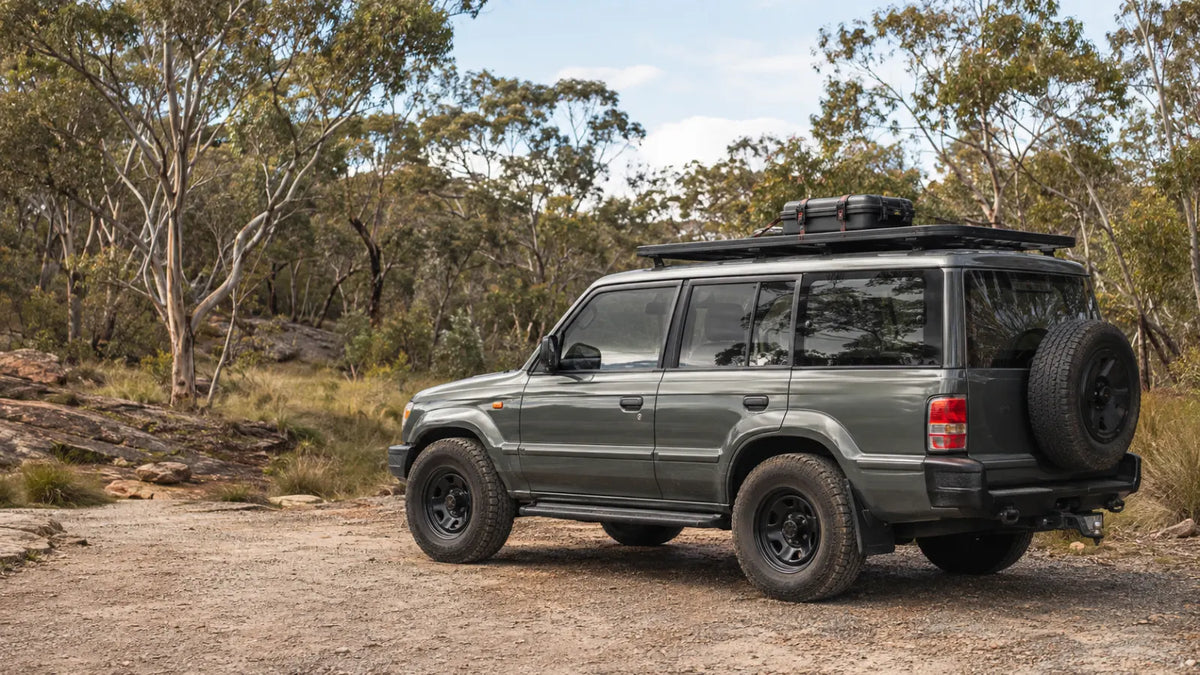
Short answer: choose a Tank 300 roof rack as part of a complete roof-load system, not as an isolated platform. The usable load is controlled by the lowest applicable limit across the vehicle roof, factory mounting points, rack, brackets, accessories and restraints. A rack’s supplier-listed capacity does not increase the vehicle manufacturer’s permitted roof load.
Vehicle roof limit first → subtract the rack and permanently attached accessories → check the remaining allowance for cargo → restrain that cargo for braking, cornering, bumps and airflow. Confirm every number for your exact Tank 300 variant and driving condition.
A roof platform can be one of the most useful Tank 300 touring upgrades. It can carry bulky but suitable equipment, support an awning and organise a camp setup. It also adds permanent mass at the highest point of the vehicle, changes total height and creates new maintenance points. The nine checks below help you compare real products without confusing rack strength with whole-vehicle approval.
Roof rack, platform or rack-and-ladder kit?
Product names are not perfectly standardised. A pair of crossbars is the lightest, simplest option for a compatible roof box or specific carrier. A full platform spreads mounting positions across a larger area and offers more tie-down flexibility. A basket adds raised edges, while a combined rack-and-ladder package provides roof access but adds more weight, projection and fitment considerations.
| System | Best suited to | Main trade-off |
|---|---|---|
| Crossbars | A defined carrier, box or occasional light load | Less deck area and fewer mounting positions |
| Low-profile platform | Touring cargo, awning brackets and modular accessories | More permanent mass, wind exposure and cost |
| Basket-style rack | Contained bulky gear with appropriate restraint | Higher profile and more potential wind noise |
| Rack plus ladder | Frequent roof access in a complete touring build | Extra mass, body clearance and access safety to check |
The 9 Tank 300 roof-rack checks
1. Confirm the exact vehicle, roof and mounting area
Start with model year, petrol or hybrid variant, roof trim, sunroof, shark-fin antenna and any factory rails or channels. “Fits Tank 300” is not enough when a listing does not specify years or mounting details. Send the supplier clear roof photos and identify anything already installed, including awning brackets, lights or a side ladder.
Ask whether the kit uses intended factory locations and whether drilling, sealant or trim removal is required. Check door and tailgate operation, antenna clearance and sunroof travel. If the vehicle has previous roof repairs or corrosion, have the mounting area inspected before loading it.
2. Find the lowest limit in the complete system
The relevant limit is not automatically the largest capacity printed beside a rack. You need the permitted roof load for your exact vehicle and operating condition, the rack and bracket limits, accessory limits, and the capacity of every restraint point used. The lowest applicable value governs the system.
Dynamic load applies while driving and must account for braking, cornering, corrugations and off-road movement. Static load describes a stationary condition and is not permission to drive with that mass. Read your current owner handbook and check with GWM or a qualified installer when the vehicle limit or off-road derating is unclear. Our Tank 300 roof-load calculation guide shows how to build the full weight budget.
3. Subtract the rack before adding cargo
The rack, brackets, ladder, light mounts, awning brackets and permanently attached hardware all consume roof-load allowance before you pack a single bag. This makes empty system weight a major buying criterion, not a minor specification.
Current Decision Maker 4X4 listings illustrate the spread: the TUFF FAB UNCIA EVO platform is listed at approximately 23.3 kg; the SUREE Freelander is approximately 36.85 kg in short form or 38.85 kg in long form; the MK Sky-Reaching rack-and-ladder setup is approximately 38.92 kg; and the MK Hunter is approximately 43.24 kg. These are listing figures to reconfirm before ordering. They do not include every accessory or your cargo unless the product page explicitly says so.
4. Inspect the load path, mounts and supplied hardware
Cargo force must travel through the rack deck, feet, brackets and vehicle mounting structure. A strong-looking perimeter rail cannot compensate for poor bracket alignment, missing hardware or an unsuitable mounting point. Ask for the installation guide, number of feet, bolt specification, torque procedure, sealing method and inspection interval.

Professional installation is a sensible default for a full platform, especially when trim removal, sealing or a ladder is involved. After fitting, every foot should sit squarely, hardware should match the instructions and nothing should interfere with roof glass, curtains, airbags, wiring or drainage paths.
5. Plan cargo position and restraint before choosing deck size
A large deck is useful only if the cargo can be positioned and restrained correctly. Keep suitable heavy items as low and central as practical, distribute mass across the supported area and avoid concentrating weight on one slat or corner. Do not rely on basket sides, friction, a cargo case latch or elastic bungee cords as the primary restraint.
The National Transport Commission’s Light Vehicle Load Restraint Guide says loads must be properly restrained, must not overhang dangerously, must stay within mass limits and must not cover lights, indicators, reflectors or number plates. It also explains that a load must remain secure during expected driving conditions, including heavy braking, cornering and acceleration.
Use suitable rated restraints and appropriate rack tie-down locations. Protect straps from sharp edges, close and lock cargo cases, remove loose items and stop early in the trip to recheck tension. A rooftop tent, spare wheel, fuel container or water container needs product-specific assessment; do not treat all roof cargo as interchangeable.
6. Measure height, length, overhang and access
Record the vehicle’s new unloaded height after installation, then calculate the loaded height for car parks, garages, branches, ferries and low structures. Include the highest point of the cargo, not just the rack rail. Check front and rear overhang, side projection, hatch clearance and whether straps or accessories can flap beyond the vehicle profile.
A ladder changes the access equation. Confirm it clears bodywork and doors, does not create unsafe edges, and is intended for the user and installed system. Climbing onto a wet or muddy vehicle carries fall risk; load and unload on stable ground and use a safer external step or assistance where appropriate.
7. Design the rack around future accessories
Decide early whether the build may include an awning, work light, shovel holder, roof box or rooftop tent. Each item adds mass, wind area, brackets and fasteners. Mounting one accessory can block another or move cargo away from the rack’s most useful zone. Our Tank 300 side-awning guide covers bracket spacing, shade direction and weather pack-down.
Do not mount lights or cargo where they obstruct the driver’s view, create glare, interfere with antennas or exceed local requirements. If your build also includes side steps, check that safe roof access is not being assumed from a product that is only designed as an entry step; see our side steps vs rock sliders guide.
8. Allow for noise, handling and fuel use
A roof rack changes airflow even when empty. Platform position, fairing, open slots and added accessories can introduce wind noise. Cargo and a rooftop tent add frontal area, while mass placed high raises the vehicle’s centre of gravity. Expect the vehicle to feel different and drive conservatively until you understand the change.
Remove unnecessary cargo, cases and accessories between trips. Listen for new rattles or whistles, and investigate rather than masking them. A change in noise can indicate airflow, loose hardware or movement. Recheck the build after corrugations and avoid assuming that a quiet highway test proves off-road security.
9. Build an inspection and maintenance routine
Before departure, inspect feet and brackets, verify the planned mass, centre the load, secure it with suitable restraints and recheck the system after a short drive. Then inspect again after hard braking, rough tracks or severe weather. Follow the product’s torque and service instructions rather than inventing a universal interval.

Clean dirt and salt from joints, keep drainage paths open and repair coating damage using a compatible method. Inspect strap wear, UV damage, corrosion, cracked welds, distorted slots and movement around feet. Stop using the system if any structural part is damaged or if the roof area shows deformation or water ingress.
Four current Tank 300 roof-rack options
The comparison below uses current store listing information. It is a starting point for fitment questions, not a substitute for the vehicle handbook, product instructions or installer assessment.
| Product | Listing evidence | Confirm before ordering |
|---|---|---|
| TUFF FAB UNCIA EVO | Aluminium-magnesium; approx. 23.3 kg; approx. 2289 × 1210 mm; light-cove and clean-profile options | Exact vehicle limit, selected option, mount layout and how listed rack capacities relate to the lower whole-vehicle limit |
| SUREE Freelander | Q235B; long and short versions; approx. 38.85 kg and 36.85 kg; sandblasted and powder-coated finish listed | Version length, installed height, empty mass and petrol/hybrid fitment |
| MK Sky-Reaching Rack & Ladder | High-strength aluminium alloy listed; approx. 38.92 kg; combined rack-and-ladder concept | Ladder/body clearance, safe access, mounting area and final vehicle height |
| MK Hunter | Manganese steel plus aluminium-magnesium alloy listed; approx. 43.24 kg | Remaining roof allowance, professional fitting, accessory plan and freight details |

Australian roadworthiness and load restraint
The Australian Design Rules are national standards covering vehicle safety and design. State and territory rules also govern in-service vehicles and modifications, so check current requirements where the vehicle is registered and used.
Queensland’s current vehicle modification guidance gives roof racks as an example of a minor accessory modification when the vehicle continues to meet all applicable standards. That example is useful, but it is not a blanket approval for every product, installation or load in every jurisdiction.
Across Australia, the practical obligations remain clear: the vehicle must stay within applicable mass and dimensional limits; the rack and load must be securely fitted; cargo must not become a hazard; and lights, indicators, reflectors and number plates must not be obscured. Confirm the current rule with your state or territory authority if the build has unusual height, projections, structural changes or lighting.
Pre-order evidence checklist
- Exact Tank 300 year, powertrain and roof configuration.
- Vehicle handbook roof-load information and any off-road condition or reduction.
- Rack empty weight, dimensions, mount count and supplied hardware.
- Installation guide, torque process, sealing method and inspection schedule.
- Planned awning, lights, ladder, box, tent and their brackets and masses.
- Remaining cargo allowance after all permanent roof components are counted.
- Suitable rated restraints and verified rack tie-down positions.
- Final unloaded and loaded vehicle height.
Frequently asked questions
How much weight can a Tank 300 roof rack carry?
There is no safe single answer based only on the rack. Use the lowest applicable limit across the exact vehicle, mounts, rack, accessories and restraints, and distinguish driving load from stationary load. Confirm the current vehicle figure in the owner handbook or with GWM.
Does the roof rack’s own weight count?
Yes. The rack, brackets, ladder and permanently attached accessories consume part of the vehicle’s roof-load allowance and also reduce the vehicle’s available payload.
Can I use a supplier-listed static capacity while driving?
No. A static figure describes a stationary condition. Driving introduces braking, cornering, bumps, airflow and vibration, so the relevant dynamic vehicle and system limits must be followed.
Should heavy items go on the roof?
Keep the centre of gravity as low as practical. Roof cargo should be suitable for the system, within all limits, distributed correctly and restrained. Dense or essential heavy gear is often better carried lower in the vehicle when a safe alternative exists.
Do I need professional installation?
For a full platform or rack-and-ladder system, professional installation is strongly recommended, especially where trim removal, sealing, drilling, electrical accessories or uncertain mounting points are involved.
Need a Tank 300 roof-rack fitment check?
Send Decision Maker 4X4 your model year, petrol or hybrid variant, roof photos and intended cargo or accessories. We can help compare product weight, fitment evidence and the questions to put to your installer.
Editorial note: Product details and approximate weights were checked against current Decision Maker 4X4 listings at publication. Reconfirm specifications before purchase. Three concept images were AI-generated to explain selection and inspection principles; they are not engineering drawings, installation instructions or certification evidence. The TUFF FAB image comes from the current store listing and was cropped for presentation. Content was manually reviewed before publication.


