Advertisement / commercial content.
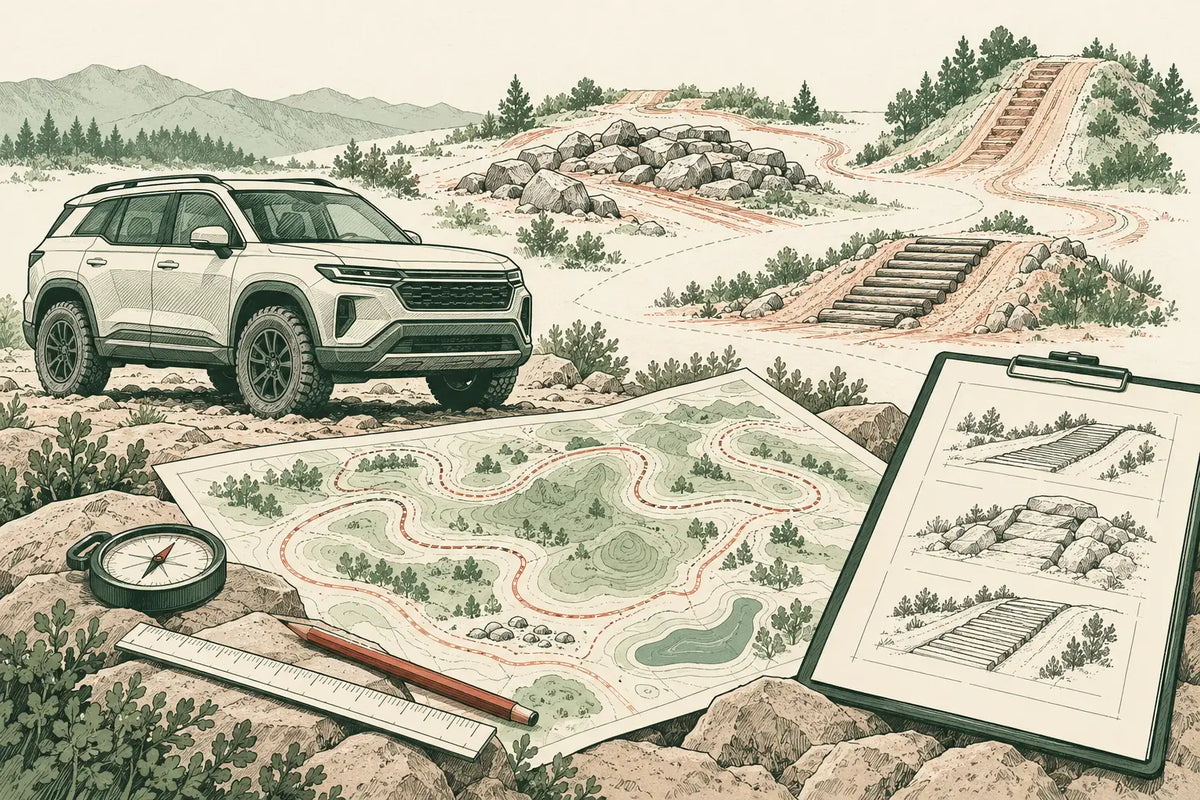
Decision Maker 4X4 is an aftermarket accessory retailer. This is an attributed development news report with editorial context. The cover and three explainers are AI illustrations, not photographs of the signing, the actual testing base or a completed vehicle test.
GWM has announced cooperation with Wuzhou to develop a comprehensive off road testing base in China. The project concerns development and validation work. It should be read separately from a published performance result for a particular vehicle or an approval for an aftermarket accessory.
Source verification date: 2026-10-31. We opened the official GWM testing base announcement, published on 2026-10-19. It reports an agreement signed in Baoding on 2026-10-18. This article reviews that October announcement, rather than presenting the signing as an event today.
In this report:
- What the agreement concerns
- Development and actual test results
- How to read a specific test
- What this means for an accessory enquiry
- Common questions
What does GWM say the cooperation will cover?
The release places the Wuzhou base around the Langya Mountain area. It describes cooperation on site design and construction, with GWM providing technical support for planning, road scenario design and calibration work. The intended programme includes vehicle reliability, terrain capability and software strategy validation.
Those details describe the purpose of the cooperation. The source is the manufacturer's announcement; we have checked its contents rather than independently inspected the ground or witnessed the proposed programme. This report does not state that construction or a particular test has been completed.
The scope matters because a development facility can appear in the same news feed as a launch, a road review or a test rating. Those records answer different questions. An agreement describes who intends to work together and on what; a test report needs details about the actual vehicle, method and result.

Why is a development programme different from a test result?
Our editorial reading is to keep the programme and the evidence from an individual test separate. A description of intended work cannot, on its own, tell a buyer how one specification performed in one set of conditions. That requires a result with an identifiable scope.
For example, a terrain scenario used during development is not automatically a capability promise for every vehicle carrying the brand badge. A useful result would identify the vehicle configuration and the conditions being assessed. Without those details, a reader should not fill the gap with a rating, a durability guarantee or a claimed limit.
This is also why we are not assigning a safety score to the announcement. Our earlier crash testing context report addresses a separate subject. A field development programme and a published crash assessment should not be treated as interchangeable evidence.
What should a reader look for in a specific test?
A practical reading checklist starts with the exact vehicle and configuration, then the surface and conditions, the test method, and the result with its limits. These are editorial questions for evaluating a future report. They are not descriptions of tests already completed at the Wuzhou site.
The vehicle detail is important when a reader has a different powertrain, trim or equipment arrangement. The conditions matter when a short image clip shows only part of a route. The method and result matter when an article uses a broad performance description without explaining what was assessed.
A report that answers those questions can be read on its own terms. It may still have limitations, but the reader can identify what the evidence actually supports. A photograph of a vehicle on a steep section does not supply the missing method, the condition of the vehicle or a numerical result.

For local driving technology context, our GWM Australia ADAS report is another dated and separate story. A development announcement in one setting does not silently update the specification or operating instructions for a vehicle in another market.
Does this announce approval for a particular accessory?
This report makes no such approval claim. The announcement concerns a manufacturer development programme. An accessory enquiry still needs information about the named product, the actual vehicle, the mounting arrangement and any applicable installation instructions.
Keep that distinction when evaluating a photograph of a modified vehicle. The visible equipment may not match the parts sold in a separate listing, and an appearance in a demonstration does not supply that product's load limits or fitment record. Ask for evidence relevant to the actual item being considered.

The useful news is the stated cooperation and its engineering purpose. The useful next step is to follow actual project updates and specific reports when they become available. Keep each conclusion attached to the record that supports it, instead of treating an agreement, a demonstration and a product claim as the same thing.
Common questions
Does this confirm the site is open to visitors?
The cooperation announcement should not be used as booking or access information. Check current operator arrangements before planning a visit.
Does it establish a performance rating for my vehicle?
A rating or performance claim would need evidence for the exact vehicle and test. This article does not assign one.
Are the images actual test site photographs?
They are labelled AI editorial illustrations. They do not show the actual base, a witnessed test or verified test results.