Choose a roof water tank by usable mounting space and the vehicle's loaded roof allowance, not by capacity alone. The current Landace roof water tank listing offers 20, 26, 30 and 36 L options. The longer tanks can carry more water, but the filled water itself adds approximately 20–36 kg before the empty tank, brackets, platform and other roof cargo are counted. The listing calls fitment universal/application-dependent; it does not certify a particular GWM TANK 300, TANK 500 or other vehicle and rack combination.
This is a buying and load-planning guide, not an installation approval or a drinking-water certification. Check the exact vehicle, roof rack and selected tank with the relevant manufacturers and a qualified installer. We have not independently weighed, fitted or water-tested the four variants.
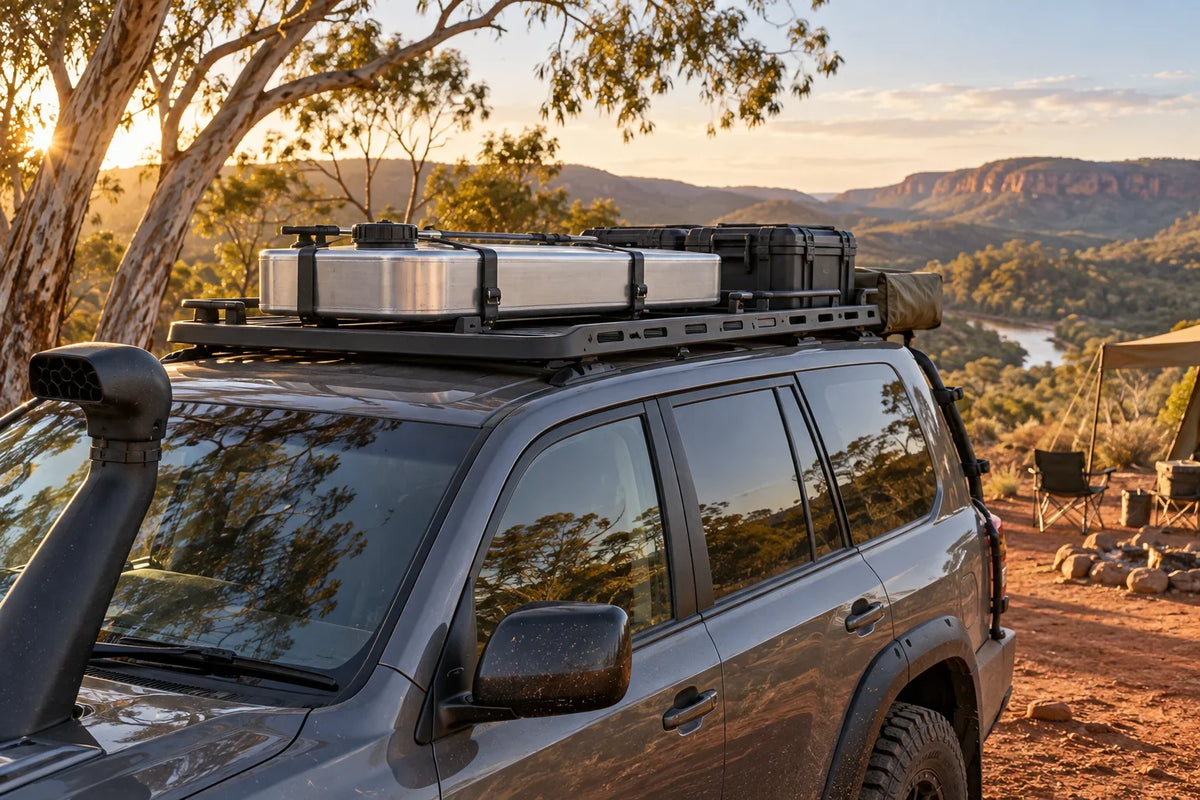
Product and guidance checked 5 October 2026. The cover is a generic AI touring concept, not a photograph of the listed tank. The three supporting graphics are original editorial explainers. Specifications and availability can change.
What are the four listed sizes?
| Variant in current listing | Listed external dimensions | Approximate mass of water when full* |
|---|---|---|
| 20 L | 1100 × 178 × 120 mm | 20 kg |
| 26 L | 1450 × 178 × 120 mm | 26 kg |
| 30 L | 1650 × 178 × 120 mm | 30 kg |
| 36 L | 1980 × 178 × 120 mm | 36 kg |
*Water is approximately 1 kg per litre. This is water mass only, not the installed system mass or a verified measured capacity. The seller's dimensions do not tell you the empty-tank mass, bracket mass, filled height above the rack, or the clear space around fittings. Ask for those before treating a particular variant as suitable.

How should a GWM owner choose between 20L and 36L?
Start with the job. A smaller tank may be enough for washing up, rinsing equipment or a short trip. More volume can be useful on a longer route, but it also occupies more platform length and carries more mass when full. Work out how much water you actually need between refills, what other gear occupies the roof, and whether the longer variant leaves access to its fill, vent and outlet. Do not assume the largest one is the best value if it crowds other gear or exceeds a load limit.
For a TANK 500 or TANK 300, confirm the exact model year, powertrain, roof system and platform hardware. A generic GWM product name is not a vehicle-specific bracket diagram. Send the seller photos and measurements of the existing rack, including crossbar or T-slot spacing and the position of lights, antennas and awnings. Ask which mounting kit is included and how it attaches to that rack. Do not drill the roof or modify factory rails based only on a catalogue picture.
What does a full roof tank do to the load budget?
RACV's roof-rack guidance says the vehicle's roof-load rating includes the rack, accessories and cargo. It also notes that a parked/static limit can differ from the driving limit. Use the applicable driving limit for a touring vehicle, and check both the vehicle and rack instructions. The lowest applicable rating governs; do not add ratings together or treat a stronger rack as permission to exceed the vehicle roof limit.
An illustrative load budget is: water + empty tank + brackets + platform/crossbars + every other roof item. For example, a filled 36 L tank contributes about 36 kg of water before its own hardware. We cannot calculate the remaining allowance for your vehicle because this listing does not supply every installed mass or your vehicle/rack rating. Ask the supplier for the empty tank and mounting-kit mass, then have an installer assess the whole roof system.

Water also moves as the vehicle accelerates, brakes and turns; a secure installation matters even when the nominal mass is within a rating. The National Transport Commission's light-vehicle load guidance says loads must be properly restrained, remain within mass limits and not create danger for other road users. Ask the installer how the tank is restrained and how the fixing points will be checked after use. Do not carry it loose or rely on an unverified improvised strap arrangement.
Four fitment questions before ordering
- Footprint: Does the selected 1100–1980 mm tank length fit the clear, usable platform space with allowance for end fittings and other accessories?
- Mounting: Are the bracket, fasteners and T-slot/profile actually compatible with your rack, its approved loading direction and the vehicle's mounting points?
- Access: Can you reach the fill opening, vent, outlet and cleaning points without removing the tank or blocking another accessory? Confirm hose routing and leak-check access.
- Load and clearance: What is the filled installed mass, what is the allowable driving roof load, and does the complete height remain suitable for your usual car parks, branches and tracks?

Can the water be used for drinking?
The listing says the supplier uses a food-grade aluminium profile, but that description alone is not a complete certification of the assembled tank, fittings, sealants, hose and cleaning process for potable water in your intended use. It also instructs owners to clean the tank before use and confirm local potable-water requirements. If drinking water is your purpose, request material and certification details for the whole water path, plus maintenance instructions, before relying on it. Otherwise, treat the intended use as unconfirmed rather than assuming every rooftop tank is drinking-water ready.
The practical buying answer
Measure and check the roof system first. Choose the smallest of the four capacities that meets your realistic water requirement and fits the verified rack space, outlet arrangement and loaded roof allowance. If the tank's empty mass, mounting kit or potable-water suitability is still unclear, pause the purchase. You can compare the live 20–36 L variants after those details are confirmed. Our TANK 500 modification guide can help place roof water alongside the rest of a touring build, but it does not substitute for the exact vehicle and rack ratings.
Frequently asked questions
Does the 36L tank weigh 36 kg when installed?
No. About 36 kg is the water alone when filled to the listed volume. Add the empty tank, mounting hardware and supporting roof equipment.
Will this tank definitely fit a TANK 500 or TANK 300?
No vehicle-specific mounting approval is given in the universal listing. Confirm the model year, roof rack, dimensions, hardware and load ratings before ordering.
Is the listed tank certified for drinking water?
The product description mentions food-grade aluminium but does not provide enough information to certify the complete assembled water path. Request documentation if potable use matters.